Pierre Puget was born in Marseille, France on 16 October 1620 in a house built by his father, Simon Puget, a master stonemason, His father died when he was two as a result of a fall from scaffolding. At the age of fourteen his mother apprenticed him to a craftsman who specialised in making church furniture and he worked on the decoration of Saint-Martin church in Marseille.
In c.1638 Puget left Marseille for what is now Italy. He visited Livorno, then Florence, and finally Rome, where he worked in the workshop of a wood sculptor who introduced him to Pietro da Cortona with whom he worked. He returned to Florence to work on the decoration of the Pitti Palace. Pietro da Cortona tried to retain Puget’s services but instead he decided to return to Marseille in c.1643.
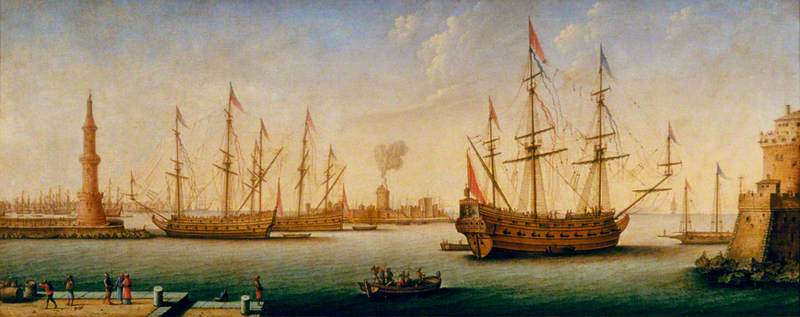
In c.1645, following the death of his mother, he joined his brother Gaspard in Toulon, who went from being a stonemason to becoming a sculptor and then an architect. About this time, he was commissioned by Admiral Jean Armand de Maillé to assist the master wood sculpture Nicolas Levray, head of the decoration workshop at the Toulon arsenal, to work on the decoration of the ship Le Magnifique.
During the Fronde (a series of civil wars in the France between 1648 and 1653), activity at the arsenal effectively ceased and Puget devoted himself mainly to painting. He worked on commissions for paintings and altarpieces for religious orders, parish churches and convents, including, in 1652, for the baptistery of Marseilles Cathedral, Le baptême de Constantin and Le baptême de Clovis. From then on although he continued to paint, Puget was drawn more to sculpture.
In 1655 he was commissioned to create two Michelangelo-style sculptural forms to support a new balcony for the town hall in Toulon. The project proved a resounding success. He then moved to Provence where he received a commission from the Marquis de Girardin to decorate the park of his castle in Vaudreuil with statues. Nicolas Fouquet, marquis de Belle-Île also commissioned him to create sculptures for the castle of Vaux-le-Vicomte and sent him to Genoa to choose the finest Carrara marbles for the statues. Following the arrest of Fouquet on a charge of corruption in September 1661, Puget prudently decided to stay in Genoa. Over the next seven years he worked sculptural projects in Marseilles and Genoa.
He returned to France in 1668 to take charge of the sculpture workshop at the Toulon arsenal where he worked until 1679. He then returned to Marseilles where he built a house on the corner of rue de Rome and rue de la Palud. He died in Marseilles on 2 December 1694.
Text source: Art History Research net (AHR net)